The Challenge
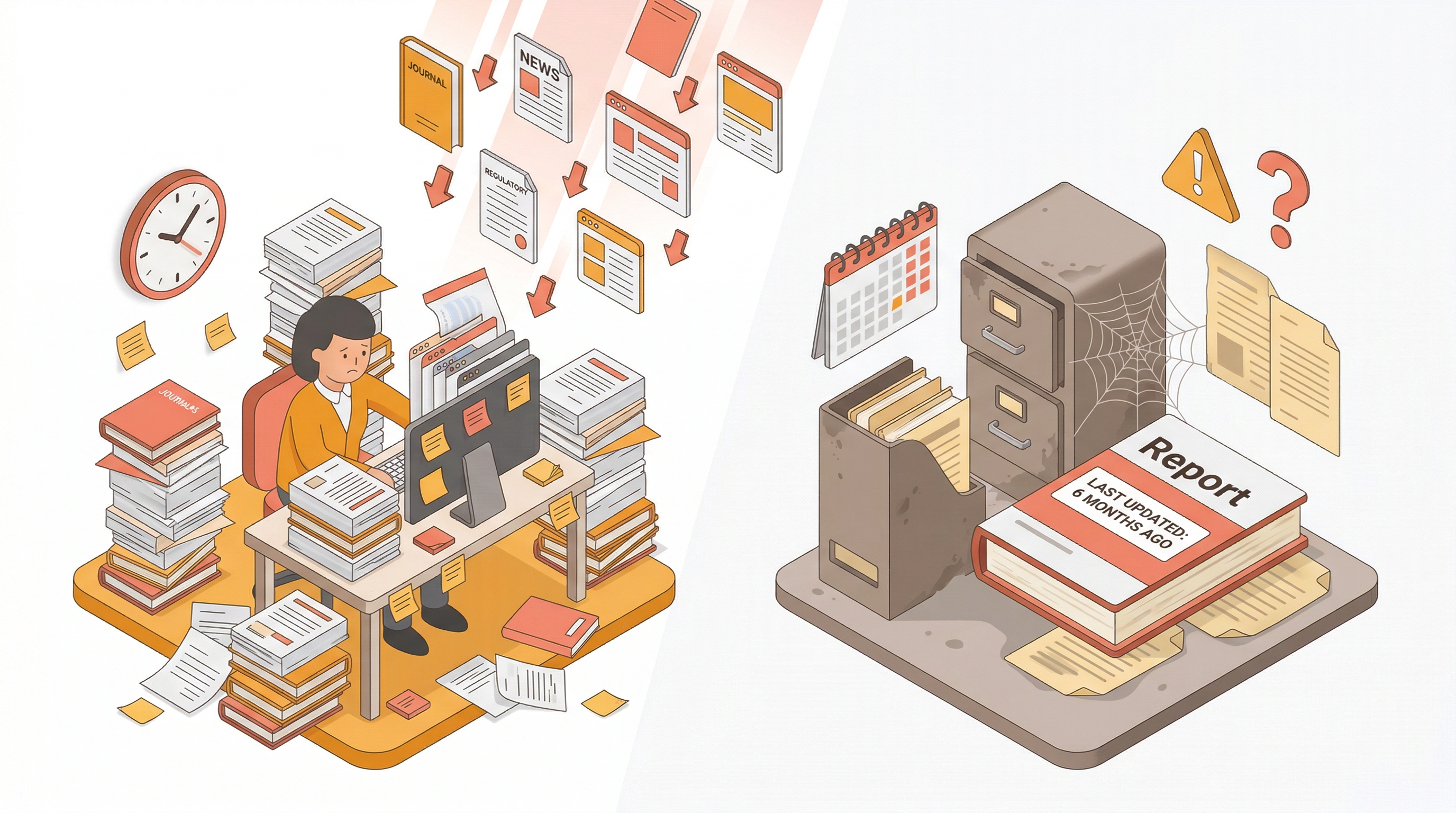
Staying current with a rapidly evolving landscape is one of the most persistent challenges across industries. Whether you are tracking competitive intelligence, monitoring regulatory trends, following methodological developments in your field, or keeping up with a specific technology area, the same problem applies: the information moves faster than any individual or team can follow manually.
The volume is part of it, but it is not the whole story. What makes landscape monitoring genuinely difficult is that the important signals are scattered across academic databases, regulatory announcements, news outlets, industry publications, and the broader web. A critical policy shift might appear on one source. A competitor's new positioning might surface on another. An emerging trend that affects your strategy might only be visible by connecting findings across several recent publications. No single search, no matter how well constructed, captures the full picture.
The consequence is predictable: landscape reviews become point-in-time snapshots that start aging the moment they are completed. Teams make decisions based on intelligence that was current three or six months ago, unaware that the field has moved on. When a stakeholder asks "what has changed since our last review?", the honest answer is usually "we do not know, because no one has had time to check."
How It's Done Today
In most organizations, landscape monitoring is either a periodic manual effort or it simply does not happen at all. Someone sets aside a few days every quarter, sometimes less frequently, to run a series of searches, scan the results, and write up a summary of what has changed. The searches are often duplicated from the last round with minor adjustments. The synthesis is done from memory and notes, because there is no structured way to compare what was found this time against what was found before.
The manual approach has several compounding weaknesses. First, it depends entirely on someone remembering to do it, and on the organization allocating protected time for a task that does not produce an immediate deliverable. Second, the scope of the search is limited by what a single person can read and absorb in the time available. Articles are skimmed rather than deeply analyzed. Full-text retrieval is selective. Sources outside the usual databases are rarely checked. Third, and most critically, there is no systematic comparison between rounds. You may notice that a new paper appeared, but identifying broader shifts, such as a theme that has strengthened, a methodology that is falling out of favor, or a regulatory position that has quietly evolved, requires the kind of structured cross-temporal analysis that manual review simply cannot support.
Some teams use alert services or RSS feeds to receive notifications when new publications match certain keywords. These help with awareness but do nothing for synthesis. You end up with a growing inbox of individual items and no structured understanding of how they connect to each other or to what you already knew. The gap between "being notified that something was published" and "understanding what it means for your work" remains entirely manual.
See Aide Pulse in Action
Download the First Report
Review an example of the synthesized intelligence generated by Aide Pulse.
The AI-Enabled Approach
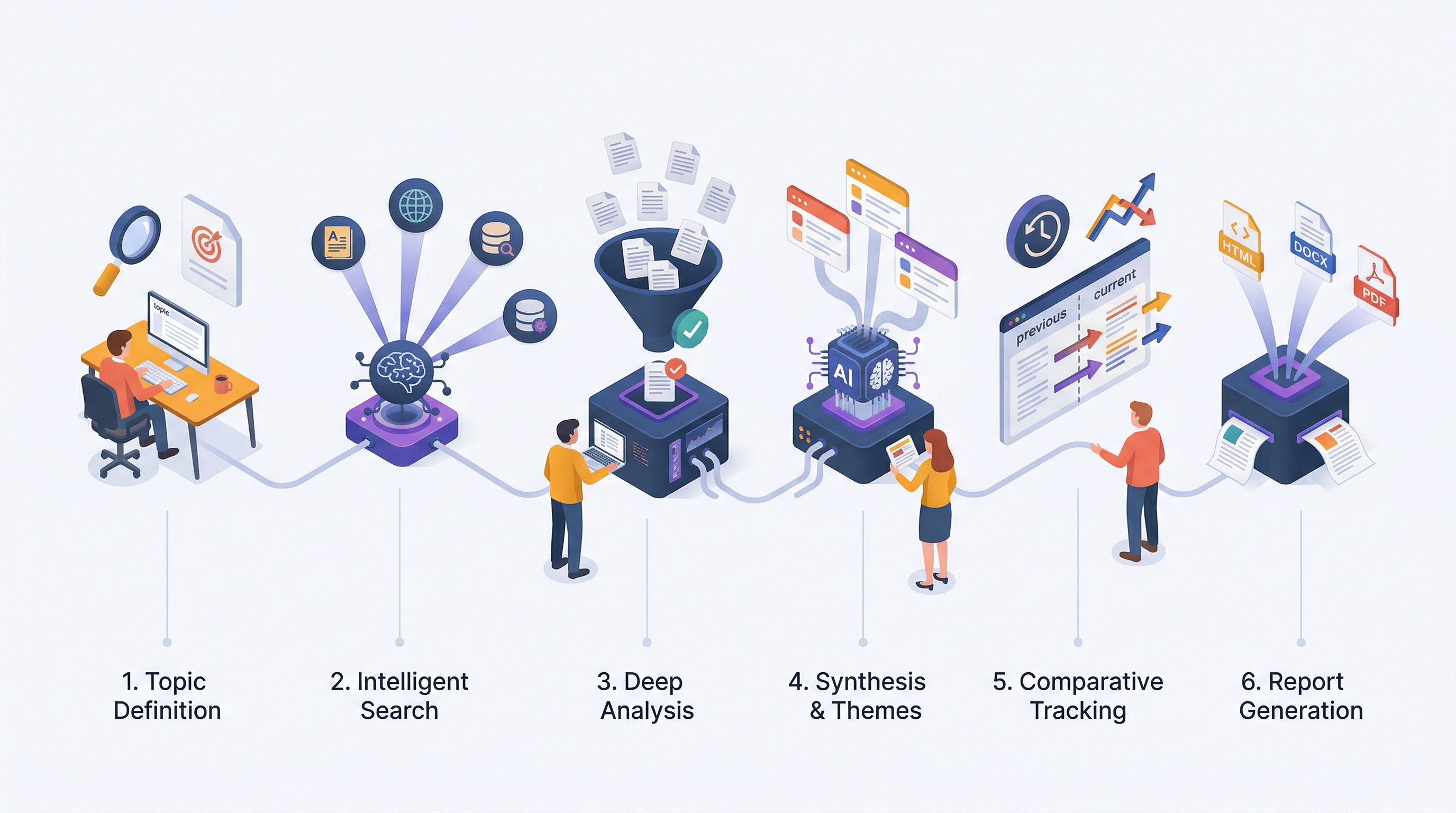
You start by defining a research topic: a disease area, a technology trend, a regulatory question, or any subject you need to stay current on. You can optionally specify the sources you care about most, the time window to cover, and any specific domains or journals to prioritize. That is the entire setup.
From there, Aide Pulse launches an intelligent, multi-source search across academic databases and the web simultaneously. The system generates optimized search queries for each source, retrieves results in parallel, and deduplicates across all of them. Every article that passes an initial relevance filter is then retrieved in full text where possible, using academic open-access repositories, publisher APIs, and web extraction as needed. The system does not rely on abstracts alone: it reads and analyzes the full content of each source to extract structured findings using a dynamic extraction schema tailored to your specific research question.
Once all sources have been deeply analyzed, the system synthesizes the findings into a structured report organized around the key themes it identified. Each theme includes a description, the evidence supporting it, its significance, and direct quotes from the source material. The synthesis also includes a trend analysis describing the direction the field is moving, and an explicit identification of knowledge gaps where evidence is thin or absent. A coverage assessment evaluates whether the evidence base is sufficient or whether important areas remain under-represented.
What Makes It Different: Comparative Tracking
The real value of Aide Pulse emerges over time. Each time you run a scan on the same topic, the system compares the current findings against the previous report. It identifies which themes are unchanged, which have evolved (and in what direction: strengthened, weakened, reversed, or become more nuanced), and which are entirely new. This comparative tracking transforms a static literature review into a living intelligence feed that tells you not just what the landscape looks like today, but how it has changed since you last checked.
The output is a formatted report available in HTML, Word, and PDF, with full references, structured sections per theme, and an executive summary suitable for sharing with stakeholders who need the highlights without the detail. Every finding is traceable to its source, and every comparison is grounded in the structured data from prior runs.
What It Means for You
- Research landscapes that would take days to survey manually are scanned, analyzed, and synthesized into structured reports automatically, covering academic literature, web sources, and news in a single pass.
- Full-text analysis goes beyond abstracts, extracting structured findings from the complete content of each source rather than relying on titles and summaries alone.
- Comparative tracking across runs tells you what has changed, what is new, and what has evolved, turning periodic snapshots into continuous intelligence.
- Themed synthesis organizes findings around the topics that matter, with significance ratings, supporting evidence, and knowledge gap identification built into every report.
- Formatted, citation-ready reports in HTML, Word, and PDF can be shared directly with stakeholders, reducing the time between research and decision-making.
- Coverage assessment flags when the evidence base is thin, so you know when findings are well supported and when they should be treated with caution.
Aide Pulse gives research teams the structured, continuously updated intelligence they need to make decisions based on what the evidence landscape looks like today, not what it looked like six months ago.
Stay Informed
Free Newsletter: AI in Health Technology Assessment
We publish a regular newsletter on AI developments in health technology assessment, powered by Aide Pulse. It covers regulatory trends, methodological advances, and emerging applications of AI across the HTA landscape. If you would like to receive it, get in touch and let us know you are interested. We will add you to the distribution list.
Custom Monitoring for Your Organization
Aide Pulse is fully configurable. If your team needs continuous monitoring on a specific topic, whether that is a competitive landscape, a therapeutic area, a regulatory environment, or a technology trend, we are happy to discuss how this can work for you. The sources, search strategies, time periods, and reporting formats are all customizable to fit your needs. Reach out and we will set up a conversation.